
STEI Quantum Day 2025: Opening New Insights in Quantum Technology
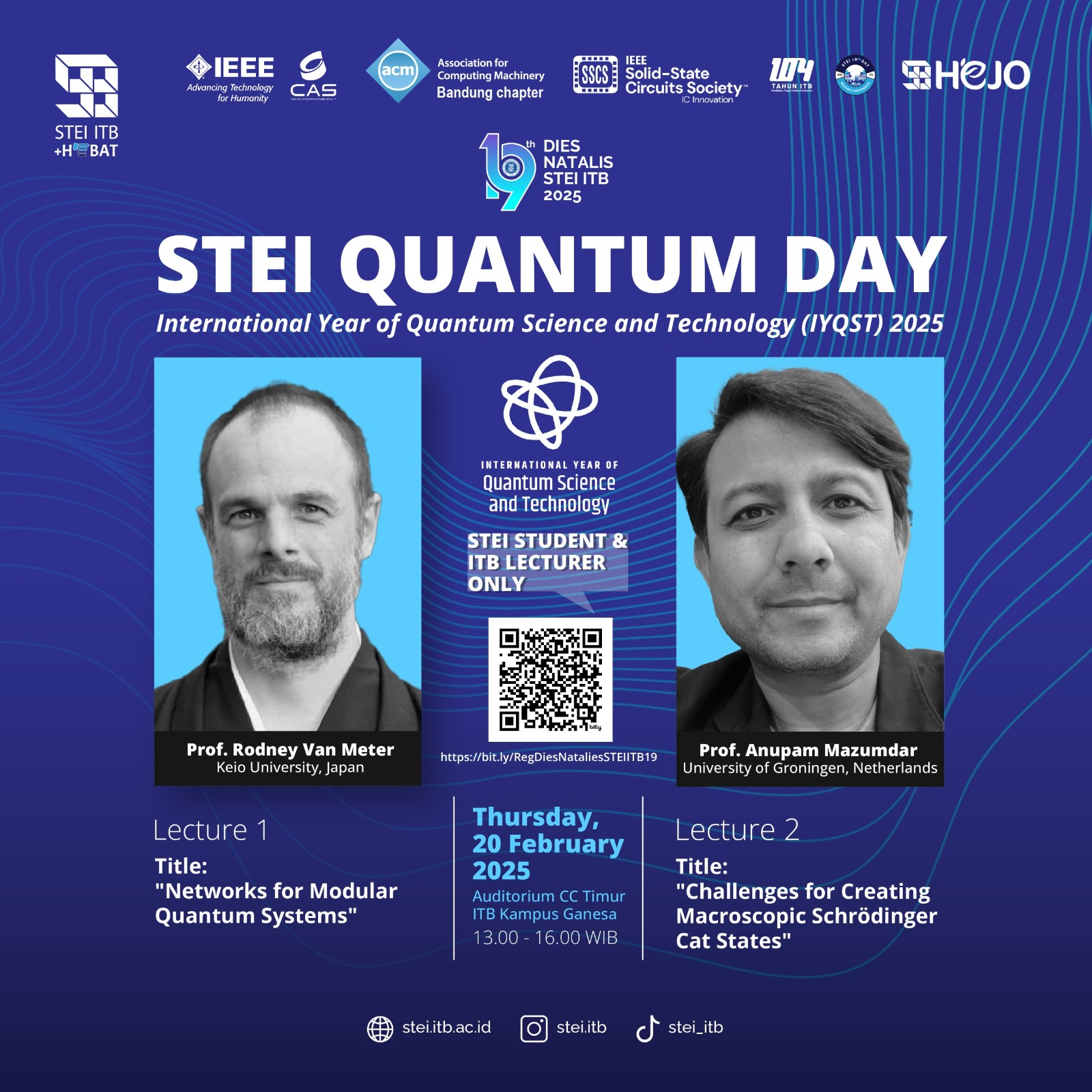
In the framework of the Bandung Institute of Technology (ITB) Anniversary celebration, STEI Quantum Day was held on February 20, 2025 at the ITB East CC Auditorium. This event opened a series of scientific discussions in celebration of ITB’s anniversary and part of the commemoration of the International Year of Quantum Science and Technology (IYQST) 2025.
Public Lectures by International Experts
Two international experts in the field of quantum technology were present to share the latest insights:
- Prof. Rodney Van Meter (Keio University, Japan) discussed “Networks for Modular Quantum System”, which explores the development of networks in modular quantum systems.
- Prof. Anupam Mazumdar (University of Groningen, Netherlands) presented “Challenges for Creating Macroscopic Schrödinger Cat States”, highlighting the challenges in creating macroscopic cat Schrödinger states.
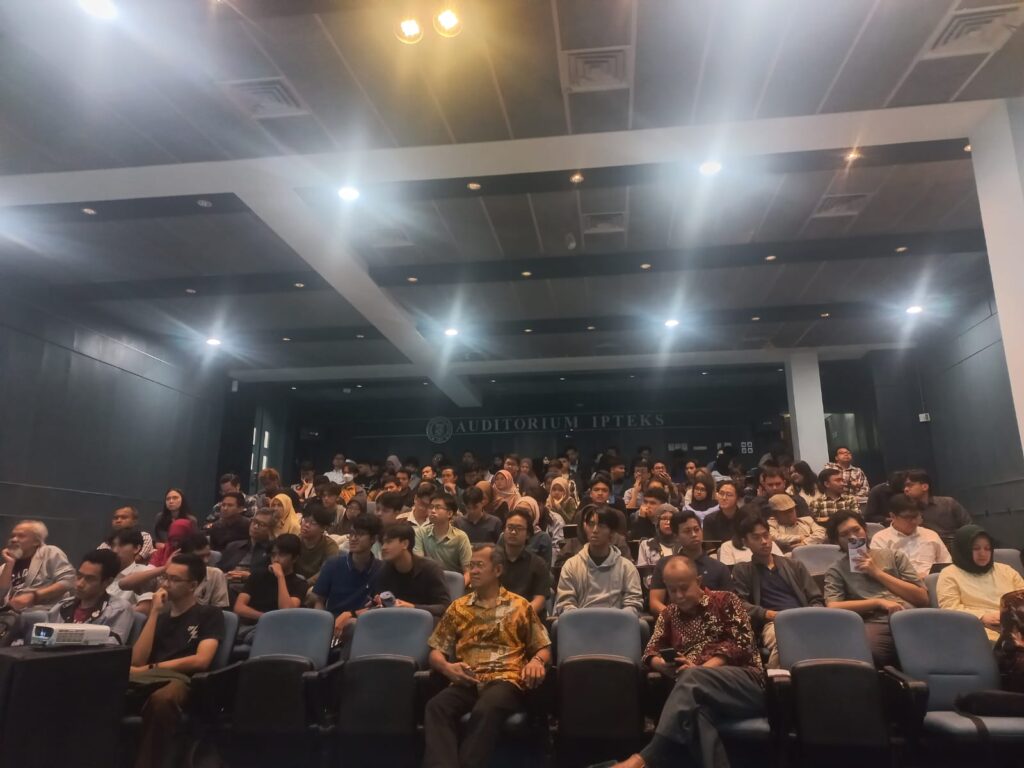
The event attracted students, lecturers, and researchers in telecommunications and quantum physics who discussed the application of quantum technology in modern industry and communications.
The Rapid Development of Quantum Technology
Quantum technology is evolving rapidly, revolutionizing computing and communications. Cross-disciplinary collaboration is key, as IBM is doing with more than 1,000 experts developing quantum computing. One important breakthrough is the Quantum Internet, which enables quantum communications and computing to be connected securely and efficiently.
Since 2019, various studies have developed protocols based on quantum entanglement, a fundamental concept confirmed through Nobel Prize-winning experiments. Quantum computers offer advantages in optimization, computational chemistry, and material design, based on seven key principles: superposition, interference, entanglement, unitary evolution, measurement, decoherence, and the no-cloning theorem.
In addition, quantum programming opens up opportunities in game analysis, industrial simulation, as well as threats to classical encryption, prompting the development of post-quantum cryptography (PQC). Cutting-edge experiments such as Schrödinger cat states and NV-centered nanodiamonds promise new applications, ranging from early detection of earthquakes and tsunamis to dark matter exploration.
With great potential in many fields, the development of quantum technologies requires global collaboration to achieve extreme quantum manipulation and realize future innovations.